Curtains can be gorgeous and still look wrong. A rod hung too low, a bracket that’s bowing, panels that stop an inch short of the floor. Nobody can say exactly what’s off, but everybody senses it.
Nine times out of ten, the culprit is the hardware.
Quick Answer: What Rod, What Size, How High?
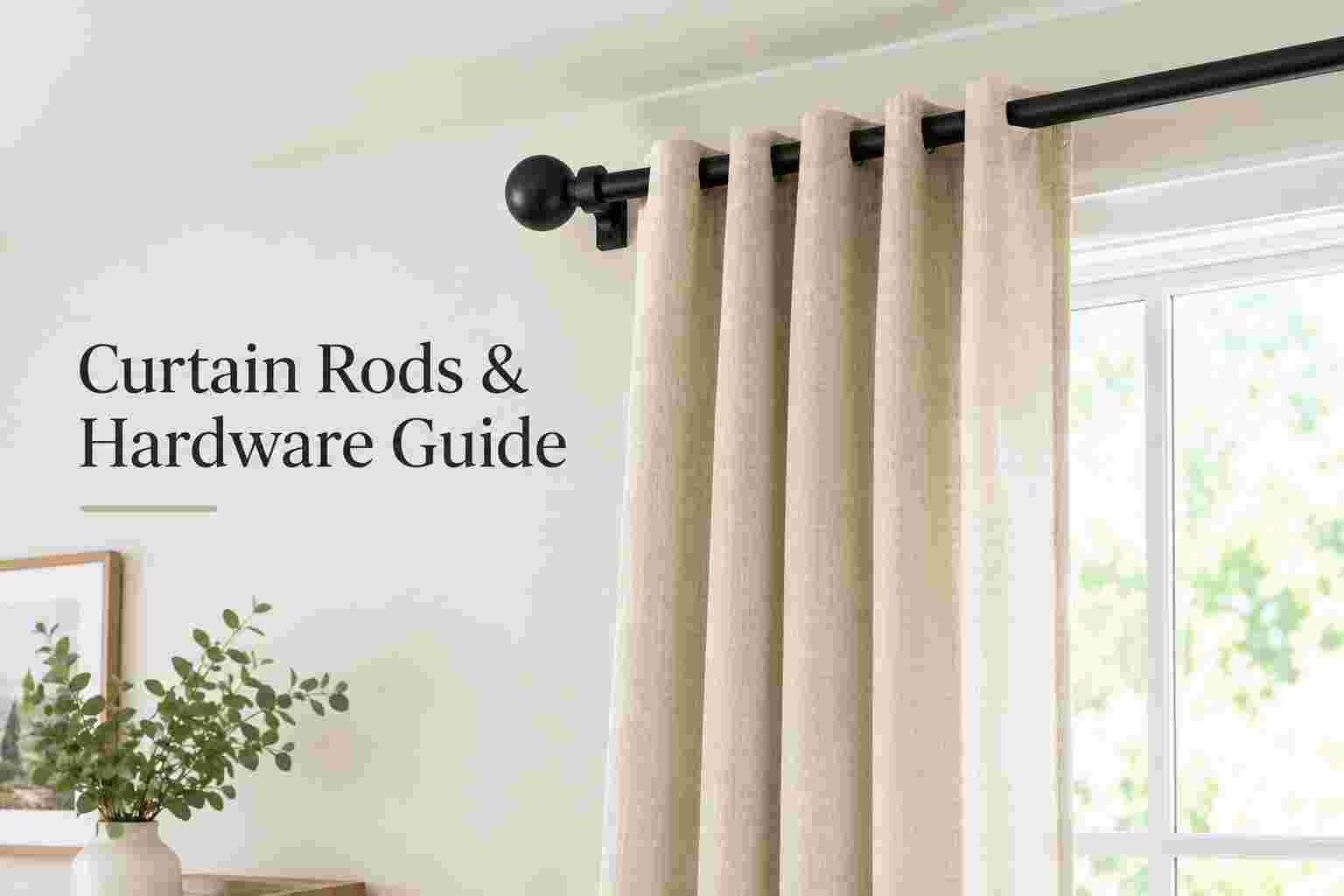
Pick a rod with enough diameter to carry your fabric, add a centre bracket for anything wider than about four feet, extend it several inches past each side of the window, and mount it roughly four to six inches above the frame, or higher if your ceilings allow. Let the curtains just kiss the floor.
What Types of Curtain Rods Are There?
| Type | Best for | Notes |
| Standard single rod | Most windows and lined panels | The everyday choice |
| Double rod | Sheers behind drapes, or curtains with a liner | Two layers, two positions |
| Traverse rod or track | Wide windows, pleated drapery, patio doors | Pull a cord or use a motor to glide panels |
| Wraparound (return) rod | Blackout and bedrooms | Curves back to the wall to stop light leaks |
| Tension rod | Light fabrics, bathrooms, inside a recess | Low weight limit, not for heavy drapery |
| Ceiling-mounted track | High ceilings and a streamlined look | Hangs from the ceiling, hides well |
| Motorized track | Tall or hard-to-reach windows | Remote or app control |
Doing a layered look? Our guide to pairing curtains and blinds shows how double rods and blinds work together.
What Size Curtain Rod Do You Need?
Diameter is about weight. Light fabrics float on a thin rod, but heavy lined drapery on a skinny one will sag.
| Rod diameter | Typically suits |
| About 5/8 to 3/4 inch | Sheers and lightweight panels |
| About 1 inch | Standard lined curtains on average windows |
| About 1.25 to 1.5 inches or larger | Heavy lined drapery, velvet, wide spans |
Length matters too. Rods longer than roughly four feet usually need a centre support bracket. For very long spans, around ten feet and up, a track or a reinforced system is often a better answer than a single long rod.
How Far Should the Rod Extend Past the Window?
If you want the glass to show when curtains are open, the rod needs to extend beyond the frame so the panels stack on the wall instead of over the window.
- Minimum: 3 to 4 inches each side.
- Better: 8 to 12 inches each side, so the curtains clear the glass completely.
- Tight on space? Consider a wraparound rod or panels that stack more compactly.
Window and panel measurements are covered in our guide on how to measure your window for curtains.
How High Should You Hang Curtain Rods?
Standard advice says four to six inches above the window frame, and that’s a fine baseline. Go higher and the room feels taller. Calgary’s newer homes with 9-foot ceilings can usually go well above that, even near the ceiling.
Options:
- 4 to 6 inches above the frame. Safe and classic.
- Halfway between frame and ceiling. A balanced look for 8-foot ceilings.
- Close to the ceiling. Dramatic height, great for rooms that feel short.
- Ceiling-mounted. A seamless, modern look.
If you’re torn between going up or sticking to the wall, our comparison of ceiling-mounted vs. window-mounted curtains walks through the tradeoffs.
How Long Should Curtains Be?
- Floor-kissing: Just touches. Looks sharp, but needs accurate measuring.
- Half-inch above: The most forgiving. Clears dust and rugs.
- Puddled: Extra fabric on the floor. A romantic, relaxed look, and a lot of vacuuming.
And for width, aim for fabric that’s about two to two and a half times the rod width. Anything flatter looks skimpy.
What About Brackets, Finials and Finishes?
Hardware is the jewellery. Pick a finish that echoes something already in the room: matte black for modern lines, brushed brass for warmth, wood for a lodge feel. Finials add personality; simple ends keep it quiet.
Brackets deserve more attention than they get:
- Heavy drapery needs brackets anchored into studs, or the right wall anchors for drywall.
- Spacing matters. A centre bracket stops the dreaded mid-rod droop.
- Projection (how far the rod sits from the wall) should clear your panels and any blinds underneath.
Common Mistakes (And Easy Fixes)
- Rod too low. It chops the window and makes ceilings feel shorter. Raise it.
- Rod too narrow. Panels cover the glass. Extend it past the frame.
- Rod too thin for the fabric. Sagging follows. Step up the diameter.
- No centre bracket. Add one on spans of four feet and over.
- Curtains too short. They look like they’ve shrunk. Re-measure to the floor.
- Mismatched hardware. Keep metals consistent through the room.
When Should You Go Custom?
Off-the-shelf rods work for standard windows. Odd widths, bay windows, extra-heavy drapery and anything with a motor are another story. A custom rod can be cut to your exact length, bent to fit a bay, and finished to match. We make custom curtain rods for exactly those situations.
Key Takeaways
- Match rod diameter to fabric weight.
- Add a centre bracket on anything over about four feet.
- Extend the rod 8 to 12 inches past each side for maximum glass.
- Hang four to six inches above the frame, or higher for drama.
- Curtains should be two to two and a half times the rod width.
FAQs
How high above the window should I hang a curtain rod?
Four to six inches above the frame is a safe default. With higher ceilings, mounting closer to the ceiling can make the room feel taller.
How far past the window should a rod extend?
At least 3 to 4 inches each side. For curtains that fully clear the glass, 8 to 12 inches each side works better.
What size rod do I need for heavy curtains?
Go for a 1.25-inch diameter or larger, with brackets anchored properly, and a centre support on any wide span.
Do I need a centre bracket?
For rods over about four feet, yes. It prevents sagging and takes the strain off the end brackets.
Do curtain rods have to go into studs?
For heavy drapery, studs or proper heavy-duty anchors are the safest choice. Light curtains can sometimes use appropriate drywall anchors.
Summary
Good hardware makes good curtains. Choose the right rod type, size it for the fabric, hang it high and wide, and support the middle. If you’re working with an odd window or heavy drapery, book a free in-home consultation and we’ll sort out the hardware together.