Ask most people why they want honeycomb blinds and they’ll say “insulation.” Fair enough — that’s the reputation these blinds have earned, and it’s deserved (we cover that side of things in detail in how honeycomb blinds save energy in Calgary winters). But opacity is the other half of the decision, and it’s the half that gets skipped over more often than it should.
The Honeycomb Structure, Briefly
The pleated cells that give honeycomb blinds their name trap air, which is where the insulation benefit comes from. That structure is separate from the fabric’s opacity, though — you can get a honeycomb blind that’s an excellent insulator and still lets in plenty of light, or one that’s both insulating and nearly pitch-black. The two properties aren’t linked the way people assume.
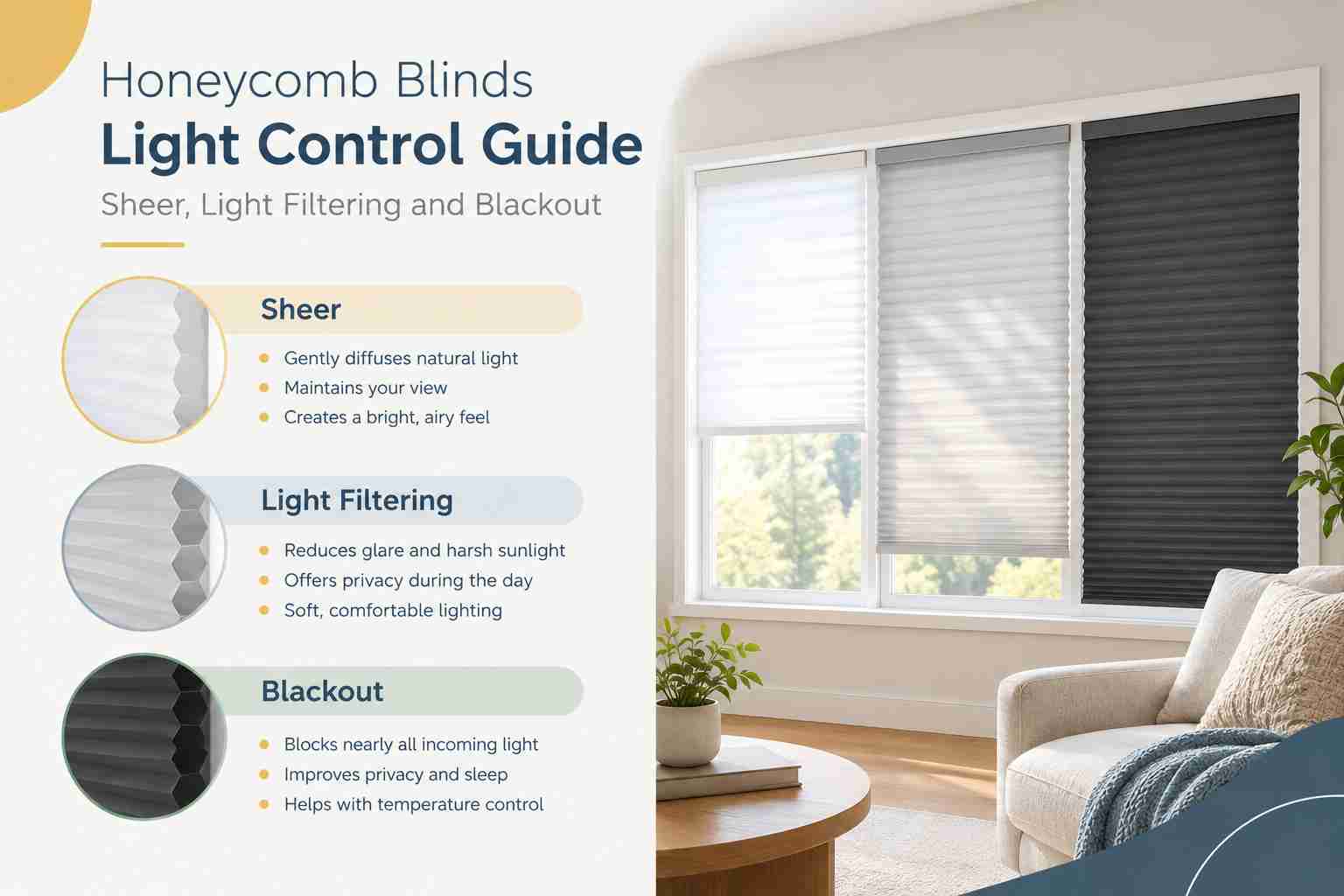
Opacity Levels at a Glance
| Opacity | What It Does | Best Rooms |
| Sheer | Softens light, keeps room bright and airy | Living rooms, kitchens |
| Light-filtering | Cuts more glare, still usable daylight | Home offices, dining rooms |
| Room-darkening | Blocks most light, some edge glow | Guest rooms, media rooms |
| Blackout | Blocks nearly all light | Bedrooms, nurseries, home theatres |
Short summary: don’t pick opacity based on “honeycomb blinds are supposed to be X” — pick it based on what that specific room needs at that specific time of day.
Sheer and Light-Filtering Options
Sheer honeycomb fabric softens daylight while keeping the room bright and airy — a good match for living rooms and kitchens where you want the insulation benefit through a Calgary winter without losing natural light in a season that’s already short on daylight. Light-filtering steps that down slightly, cutting more glare while still keeping the room usable during the day.
Blackout Honeycomb: Nurseries, Bedrooms, Home Theatres
Blackout honeycomb cells use a tighter weave or added backing to block light almost entirely. Nurseries are one of the biggest use cases we see — new parents in newer Calgary developments with big south-facing windows often need real darkness for daytime naps, not just dimming. Bedrooms benefit for the same reason, especially through summer when it doesn’t get properly dark until close to 10 pm.
There’s solid research behind this too: according to the Sleep Foundation, circadian rhythms are heavily influenced by light and darkness, and exposure to light in the evening can delay melatonin production and prolong the time it takes to fall asleep. A properly blacked-out bedroom isn’t just about comfort — it has a measurable effect on sleep quality.
Top-Down, Bottom-Up: The Feature Most People Don’t Know About
This is a honeycomb-specific option worth calling out on its own. Instead of only lowering from the top, top-down-bottom-up honeycomb blinds let you drop the top portion down while the bottom stays raised — so you get privacy at eye level while still letting light in from above. It’s particularly good for street-facing windows or bathrooms where full coverage feels like overkill during the day.
Choosing by Room
- Living rooms and home offices: sheer or light-filtering — insulation matters, but you still want the room to feel open
- Bedrooms and nurseries: blackout, for the reasons above
- Bathrooms and street-facing rooms: top-down-bottom-up, regardless of opacity level
- Skylights and angled windows: specialty honeycomb tracks fit where standard blinds can’t
Cordless and Motorized Safety
Cordless lift systems and motorized options are widely available on honeycomb blinds now, which matters if you’ve got kids or pets in the house. Canada’s Corded Window Coverings Regulations now restrict cord length and loop size specifically to reduce strangulation risk — and Health Canada’s own guidance is that the safest window covering is one with no accessible cord at all. If you want a deeper look at cordless mechanisms across product types, see the pros and cons of cordless blinds.
Maintenance
Honeycomb cells collect dust in the pleats more than a flat roller fabric does, so a vacuum brush attachment on a low setting works better than a cloth for regular cleaning. Most fabrics tolerate this well without flattening the pleats.
Opacity is a decision worth making room by room rather than picking one finish for the whole house — a nursery and a home office have very different needs even if they’re both getting honeycomb blinds. You can see the full range across our custom blinds Calgary lineup.
Key Takeaways
- Insulation and opacity are separate properties — you can have both blackout and high energy efficiency in one honeycomb blind
- Sheer/light-filtering suits living spaces; blackout suits bedrooms and nurseries
- Top-down-bottom-up is a honeycomb-specific feature worth asking about for street-facing rooms
- Cordless and motorized options meet current Health Canada safety standards and are worth prioritizing for homes with kids or pets
- Cleaning honeycomb cells requires a soft brush, not a cloth, to avoid flattening the pleats
Summary
Honeycomb blinds do more than insulate — the opacity you choose shapes how each room actually functions day to day. Match sheer or light-filtering to living spaces, blackout to bedrooms and nurseries, and consider top-down-bottom-up for privacy-sensitive windows. Book a free in-home consultation and we’ll help you match opacity to each room, not just the insulation rating.
FAQs
Can honeycomb blinds be both energy-efficient and blackout?
Yes — the cellular structure that provides insulation is independent of the fabric’s opacity, so you can get a blackout honeycomb blind that still insulates as well as a sheer one.
What is top-down-bottom-up honeycomb?
A lift system that lets you lower the top of the shade independently of the bottom, so you can get privacy at eye level while still letting light in above — popular for street-facing rooms and bathrooms.
Are cordless honeycomb blinds safe for kids’ rooms?
Yes. Cordless and motorized lift systems remove the dangling cord entirely, aligning with Health Canada’s current safety guidance for homes with young children.
Do honeycomb blinds work for skylights?
Yes, with specialty tracking designed for angled and skylight windows — standard blinds typically can’t be mounted this way.
How do I clean honeycomb blinds without flattening the pleats?
A vacuum with a soft brush attachment on a low setting is the safest approach; most fabrics hold their shape well under normal cleaning.