You’ve picked the blinds. The colour’s decided. Then somebody asks, “Inside mount or outside?” and the whole conversation stalls.It sounds like a small detail. It isn’t. The mount changes how the blind looks, how much light slips around it, and whether it fits your window at all.
Quick Answer: Inside Mount or Outside Mount?
Choose inside mount if your window frame is deep enough and you like a clean, built-in look. Choose outside mount if the frame is shallow, you want maximum light blocking, or you’d like the window to look bigger. When depth is borderline, outside mount is the safer bet.
What Do “Inside” and “Outside” Actually Mean?
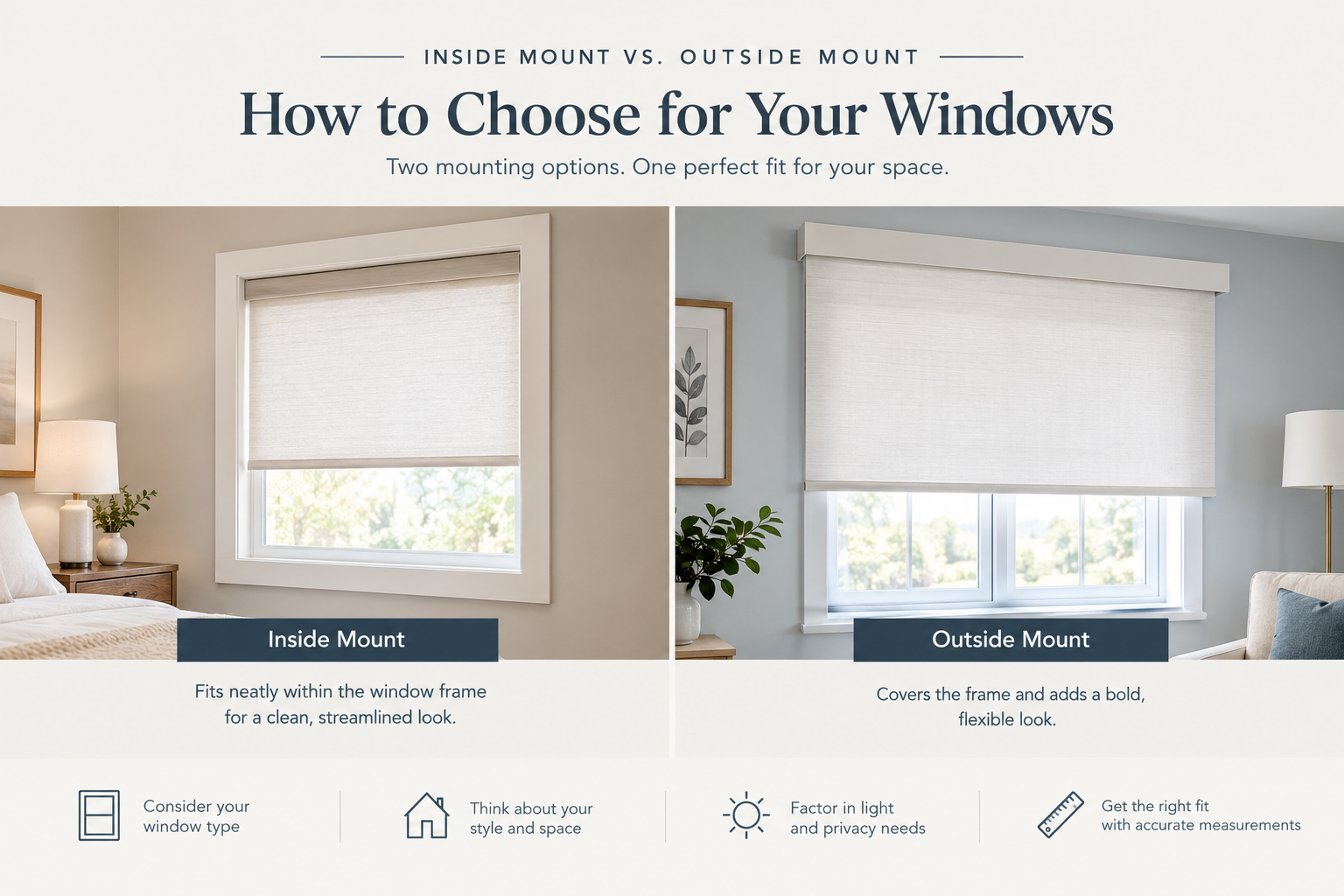
- Inside mount: The blind sits inside the window recess, within the frame.
- Outside mount: The blind mounts on the wall, trim or ceiling above the window, covering the opening and some of the surrounding wall.
That’s it. Everything else is the tradeoffs.
What Are the Pros and Cons of Inside Mount?
Pros
- Tidy, tailored look. The window frame stays visible.
- Blind stays out of the room, so furniture and curtains aren’t crowded.
- Often feels more “finished” on deep, wrapped windows.
Cons
- Needs enough depth for the headrail and fabric to sit within the recess.
- Leaves a small gap along each side, so light bleeds around the edges.
- Needs precise measuring, because there’s very little room for error.
- Window cranks, handles or locks can get in the way.
What Are the Pros and Cons of Outside Mount?
Pros
- Works on shallow or obstructed windows.
- Overlaps the frame, so it blocks more light and gives better privacy.
- Hides uneven or ugly window frames.
- Can make a window look wider or taller.
Cons
- Covers the trim and frame, so you lose that detail.
- Takes up more space in front of the window.
- Needs wall or trim solid enough to hold the brackets.
- May collide with furniture or curtains if the room is tight.
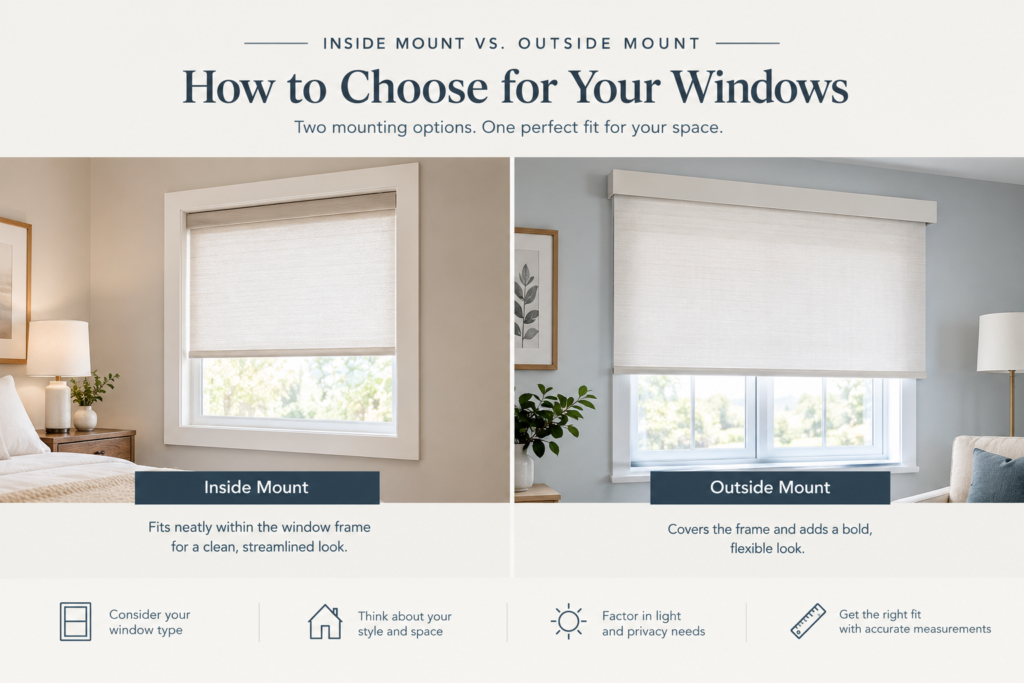
Inside vs. Outside Mount: Side-by-Side
| Question | Inside mount | Outside mount |
| Look | Clean, built-in | Bold, covers the frame |
| Light blocking | Small side gaps | Better, with overlap |
| Window depth needed | Moderate to deep | Any depth |
| Privacy | Good | Better |
| Measuring tolerance | Very tight | More forgiving |
| Works with cranks and handles | Sometimes not | Usually yes |
| Makes window look bigger | No | Yes |
How Deep Does the Window Need to Be?
This is the deciding factor most of the time. As a rough guide:
| Depth of recess | What usually works inside |
| Under about 2 inches | Slim-profile roller and cellular options; often outside mount is easier |
| About 2 to 3 inches | Most blinds, including many zebra and roller styles |
| 3 inches or more | Thicker products like wood blinds and some Roman shades |
Treat those as ballparks. Different brands and lift systems vary, and some products can sit partly proud of the frame. If you’re looking at custom wood blinds, check the depth requirement before you fall in love with them.
Which Mount Suits Which Calgary Home?
- New builds: Many have deeper drywall returns, so inside mount often works well. Newer windows can also be recessed deeper, which suits cellular and roller shades.
- Older bungalows and character homes: Shallow wood casings are common. Outside mount on the trim is often cleaner.
- Condos: Aluminum frames can be shallow, and some windows are surrounded by concrete or drywall. Outside mount over the frame usually does the trick.
- Basements: Windows tend to be small and shallow, and they’re often hoppers or sliders. Outside mount is usually easiest.
- Kitchen windows: Deep sills, faucet clearance and splash zones all matter. Inside mount can look sharp, but check the sill.
- Bedrooms: If darkness matters, outside mount helps close those edge gaps.
What If You Have Cranks, Handles or Locks?
Casement windows with a crank, or sliders with a lock, can block an inside-mounted blind. Your options are an outside mount, a smaller shade that clears the hardware, or a blind that sits slightly forward of the glass. Tell your installer up front. Hardware surprises on installation day are no fun.
How Do You Measure Each One?
We’d rather measure for you, but here’s the idea.
Inside mount
- Measure the width at the top, middle and bottom. Use the narrowest.
- Measure the height at the left, centre and right.
- Measure the depth.
- Don’t deduct anything yourself. Manufacturers allow for clearance.
Outside mount
- Measure the area you want to cover, plus overlap on each side. Roughly 1.5 to 3 inches is common.
- Add height above the window if you want to hide the headrail or clear the trim.
- Check that the wall has solid material for the brackets.
Curtains are a different calculation, so if you’re hanging drapery too, see how to measure for curtains.
Can You Mix Mounts in the Same Room?
You can, but it can look inconsistent. If two windows sit side by side, go with the same mount for both. If one window has a shallow frame and the other doesn’t, outside mount all of them for a uniform line.
What Happens on Install Day?
Good installers check level, brackets and clearances. If you’re curious how the visit goes, we’ve written up what to expect when you book installation.
Key Takeaways
- Inside mount is neater; outside mount blocks more light.
- Window depth usually decides it.
- Shallow frames, cranks and uneven trim point to outside mount.
- Don’t trim your own measurements. Let the maker allow for clearance.
- Use the same mount across neighbouring windows.
FAQs
Which mount blocks more light?
Outside mount, because it overlaps the frame and closes the gaps inside mount leaves along the sides.
Can any blind be inside mounted?
Only if the window has enough depth for that product. Shallow windows usually need an outside mount.
How much should an outside mount overlap the window?
Roughly 1.5 to 3 inches each side is common, depending on the light control and look you want.
Is inside mount more expensive?
Price follows size, fabric and system more than the mount. Outside mounts are often wider, which can add a little.
Should I measure myself or have it done?
Either works, but inside mounts leave little room for error, so having it measured professionally saves headaches.
Summary
Inside mount gives you the clean look; outside mount gives you the coverage. Check your window depth first, think about cranks and light, and choose the same mount for neighbouring windows. Not sure? Book a free in-home consultation and we’ll tell you what your frames will actually allow.