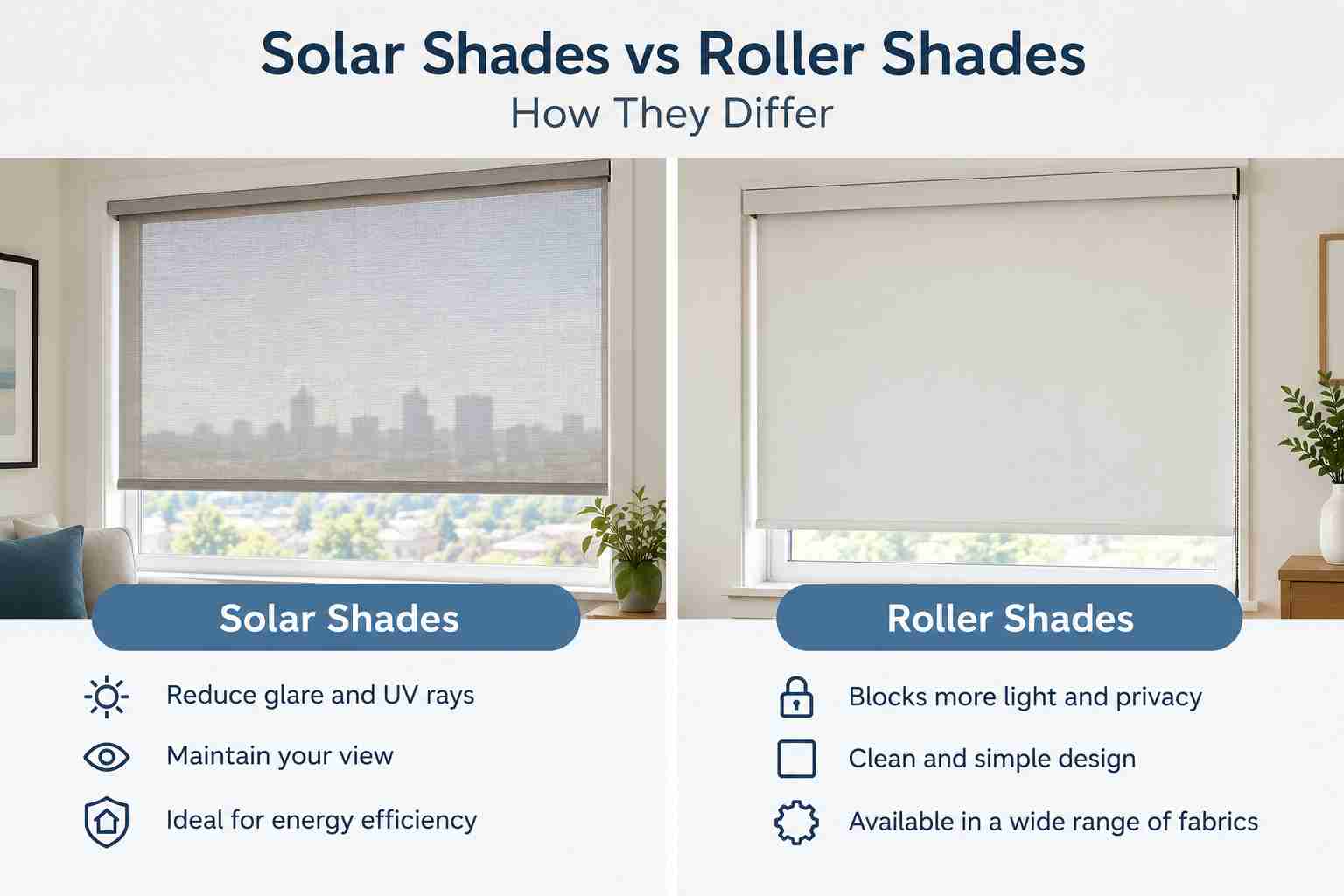
Walk into any Calgary window covering showroom and ask about “roller shades,” and there’s a decent chance you’ll get shown a solar shade too — because from across the room, they genuinely look the same. Same clean roll-up mechanism, same low-profile headrail, same smooth, no-pleat look. But the fabric doing the actual work is built for two completely different jobs, and picking the wrong one means either losing your view or not getting the light control you actually needed.
Here’s what separates them, and how to figure out which one fits your Calgary windows.
The Core Difference in One Sentence
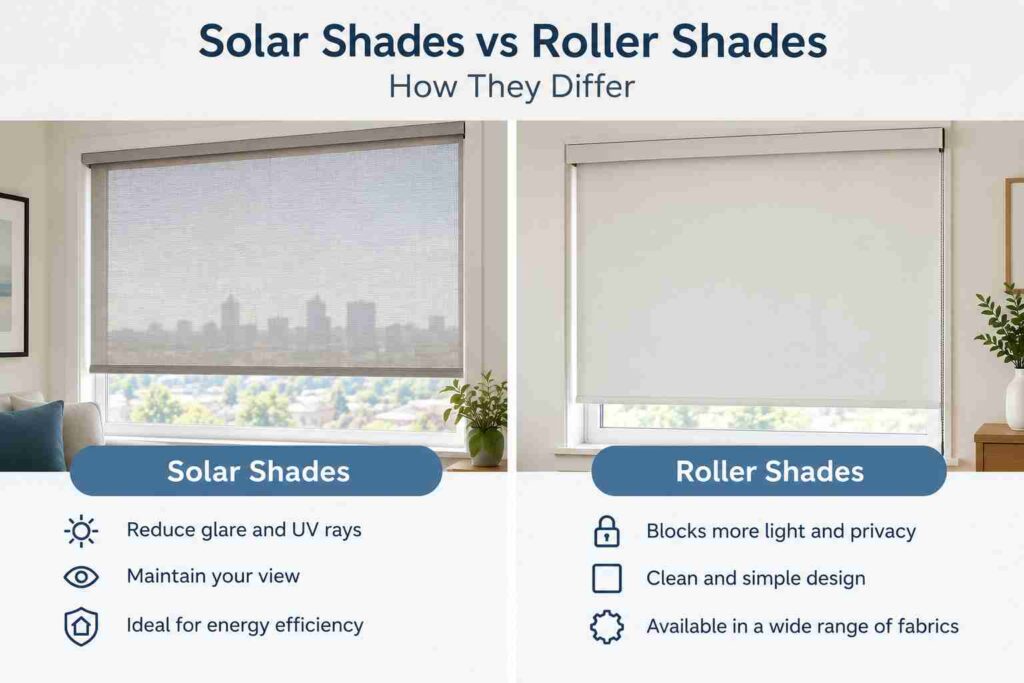
Roller shades are built to control how much light enters a room. Solar shades are built to filter sunlight — light, heat, and UV — while preserving your view to the outside. That one distinction drives everything else: the fabric, the look, the privacy level, and where each one actually belongs in your home.
How the Fabric Actually Differs
| Feature | Roller Shades | Solar Shades |
| Fabric type | Solid, tightly woven fabric (polyester, vinyl-coated) | Open-weave mesh (fiberglass, vinyl, or acrylic blend) |
| Light control | Blocks light — up to full blackout available | Filters light while maintaining a view |
| UV protection | Blocks visible light, not specifically engineered for UV | Specifically engineered to block UV rays |
| Outdoor view | None when closed (opaque fabric) | Maintained, depending on openness percentage |
| Daytime privacy | Full privacy when closed | Good — outsiders can’t see in during daylight |
| Nighttime privacy | Full privacy | Poor — shade becomes see-through with lights on inside |
| Color/pattern range | Wide — solids, patterns, textures | Narrower — mostly neutral tones |
What “Openness Factor” Actually Means
This is the term that trips people up most, and it’s worth understanding before you buy. Solar shade fabric is rated by an openness factor, expressed as a percentage — the amount of open space woven into the fabric.
- 1% openness blocks roughly 99% of UV rays and light, offering the tightest weave and lowest visibility through the fabric.
- 5% openness is a common middle-ground choice, balancing glare control with a workable outdoor view.
- 10–14% openness lets in noticeably more light and preserves a clearer view outside, at the cost of less aggressive UV and glare blocking.
Think of it like sunglasses for your window: a darker lens (lower openness) blocks more glare and gives more privacy during the day, while a lighter lens (higher openness) lets in more daylight and shows more of the outdoor scene. There’s no universally “correct” number — it depends on which direction your window faces and how strong the sun gets in that room.
Where Each One Makes Sense in a Calgary Home
Calgary’s combination of intense summer sun, over 300 days of measurable sunshine a year, and cold winters means light control and heat management both matter — just in different rooms.
Solar shades work best in:
- South- and west-facing living rooms that catch strong afternoon sun
- Home offices, to cut screen glare without blacking out the room
- Sunrooms, where keeping the outdoor view matters
- Rooms with hardwood floors, art, or furniture prone to sun fading
Roller shades work best in:
- Bedrooms, where full blackout or near-blackout matters for sleep
- Media rooms, for screen visibility and light control
- Bathrooms, where full nighttime privacy is non-negotiable
- Any room where style, pattern, or colour matters as much as function
Quick summary: if the priority is “I want to see outside and stop the glare,” go solar. If the priority is “I want this room dark and private,” go roller.
The Privacy Trade-Off Nobody Mentions Upfront
This is the one detail that catches people off guard after installation: solar shades behave completely differently depending on the time of day. During daylight hours, the mesh weave means people outside can’t really see into your home, even though you can see out. But at night, with interior lights on, that relationship flips — the shade becomes noticeably more see-through from the outside looking in.
That’s a real consideration for Calgary homes close to neighbours, on busy streets, or with ground-floor windows facing sidewalks. It doesn’t rule solar shades out — but it usually means solar shades in a front-facing living room get paired with something else at night, whether that’s our custom curtains and drapery layered behind them, or roller shades in bedrooms where full privacy matters more.
UV and Sun Damage: Why This Matters More in Calgary
Calgary gets more annual sunshine hours than almost any other major Canadian city, which means UV exposure through windows is a bigger factor here than it is in cloudier markets. Over years, unfiltered UV exposure fades hardwood floors, upholstery, artwork, and rugs — damage that’s slow enough you don’t notice it happening until the difference under a rug or picture frame becomes obvious.
Solar shades are specifically engineered to reduce that kind of UV exposure while still letting the room feel bright and lived-in, which is the main reason they’ve become popular for Calgary living rooms and sunrooms with big, unshaded south or west exposures.
Style and Design Differences
Roller shades win on style flexibility, hands down. Because the fabric doesn’t need an open weave, roller shades come in a huge range of colors, patterns, and textures — solid neutrals, bold prints, textured linens, blackout-lined options. Solar shades are more limited, mostly sticking to neutral tones because the weave structure that gives them their UV-blocking properties doesn’t lend itself to elaborate patterns.
If style and colour matching to your décor is a top priority and light control is secondary, that alone might tip the decision toward roller shades — or toward pairing solar shades with a more decorative layer like our custom vertical sheers for texture and colour.
Motorization: Works the Same for Both
Both roller and solar shades are widely available with motorized operation — remote control, wall switch, or app-based control through a smart home system. If you’re covering several large or hard-to-reach windows, it’s worth reading our guide to motorized blinds and curtains, since the same motor systems typically work across both fabric types.
Key Takeaways
- Roller shades block light; solar shades filter light, heat, and UV while preserving your outdoor view.
- Openness factor (1% to 14%+) determines how much light, glare, and view a solar shade allows — lower numbers mean more blocking, less view.
- Solar shades offer daytime privacy but become more see-through at night with interior lights on — a real factor for street-facing Calgary homes.
- Roller shades offer far more colour and pattern options; solar shades are mostly limited to neutral tones.
- Given Calgary’s high sunshine hours, solar shades are a strong pick for UV and furniture protection in south- and west-facing rooms.
Summary
Solar and roller shades look nearly identical hanging in a showroom, but they’re solving two different problems. Roller shades are about control — blocking light, creating privacy, matching a room’s colour scheme. Solar shades are about filtering — keeping the view, cutting glare and UV, protecting furniture from years of sun exposure. In a city with as much direct sunlight as Calgary gets, a lot of homes end up using both: solar shades in the sun-drenched living spaces, roller shades in the bedrooms and bathrooms where blackout and full privacy matter more. Browse our full lineup of blinds and shades, or book your free in-home consultation and we’ll help you figure out the right openness, fabric, and room-by-room mix for your home.
FAQs
Can solar shades fully block light like roller shades?
Not entirely, and that’s by design. Even the tightest solar shade fabrics (around 1% openness) still allow a small amount of light through, since the fabric relies on an open weave to function. For full blackout, a roller shade with a dedicated blackout liner is the better choice.
Do solar shades really protect furniture and floors from fading?
Yes. Solar shade fabric is specifically engineered to block a high percentage of UV rays — often 90% or more depending on the openness factor — which significantly slows the fading that direct sun causes to hardwood, upholstery, and artwork over time.
Are solar shades private at night?
Not fully. During the day, the mesh weave prevents outsiders from seeing in while you can still see out. At night, with interior lights on, that effect reverses and the shade becomes more transparent from the outside — worth planning around for street-facing or ground-floor windows.
Which is better for a Calgary living room with big south-facing windows?
Solar shades are usually the better fit here, since they cut glare and UV while preserving the view and natural light that make a south-facing room desirable in the first place. Roller shades would block that view entirely when closed.
Can I mix solar and roller shades in the same house?
Absolutely, and many Calgary homeowners do exactly that. Solar shades tend to go in sun-heavy living areas and home offices, while roller shades cover bedrooms, media rooms, and bathrooms where full blackout and privacy matter more.